

In Production · Signups Open
Thera
Capture Intelligence for Government Contractors
AI capture intelligence for government contractors, in production and carrying real pipelines: a Digital Twin of your company, explainable bid/no-bid scoring, AI opportunity briefings, and an opt-in teaming network.
- $200/mo · $2,000/yr · 14-day free trial
- Web
- Next.js · FastAPI
- Docker on EC2
Thera helps government contractors decide what to pursue, how to pursue it, and how likely they are to win. It runs in production at thera.athenadatalabs.com, watching the federal opportunity stream: live SAM.gov notices, amendments, deadlines. It maintains a Digital Twin of your company and scores every opportunity against it, with explainable reasoning and AI-generated executive briefings. A pipeline then carries each pursuit from discovery to submission.
Scoring is a gate, not just a ranking. A set-aside your company holds no qualifying certification for is capped at Monitor no matter how well the rest of the notice fits, because a recommendation to bid work you are disqualified from is worse than no recommendation at all. We are on the other side of that gate ourselves. Athena Analytics is an SBA-certified SDVOSB, so the register Thera scores your eligibility against is one we are listed in too. Presolicitations and sources-sought notices are pulled in alongside solicitations, since that is the window where a small firm can still shape a requirement rather than react to one.
The newest half of the product points the other way. Finding a partner has always been part of capture, and Thera ranks subcontractor candidates out of public federal award data. The Thera network lets you be the company that gets found. Publish a listing and it is matched on your NAICS codes and the states you serve. It then surfaces inside another member's partner search for a live notice, ranked above the cold leads. There is no feed and nothing to post. Your listing surfaces because somebody is staffing a contract that closes in nine days, not because they thought to browse a directory.
Two things make that a market rather than another directory. A listing carries one line its owner did not write. Thera reads the public federal award record filed against your UEI, which is a different kind of claim from the certifications you typed in yourself. And being listed is measurable: you can see how often you surfaced in a real search, for how many distinct contracts, and under which codes. Not a follower count, and never who looked. Appearances in searches somebody actually ran is the only thing being listed can honestly promise to deliver, so that is the number reported.
The learning loop runs per organization: your overrides and win/loss outcomes tune the recommendations inside your own boundary, and the engine never reads another customer's data. A published network listing is the one thing that crosses between organizations, it carries only the fields you chose to fill in, and unpublishing removes it from every search immediately. One server, one database on its own encrypted volume, snapshotted nightly: the same privacy-as-architecture discipline as the rest of our product line.
Find it, score it, bid it
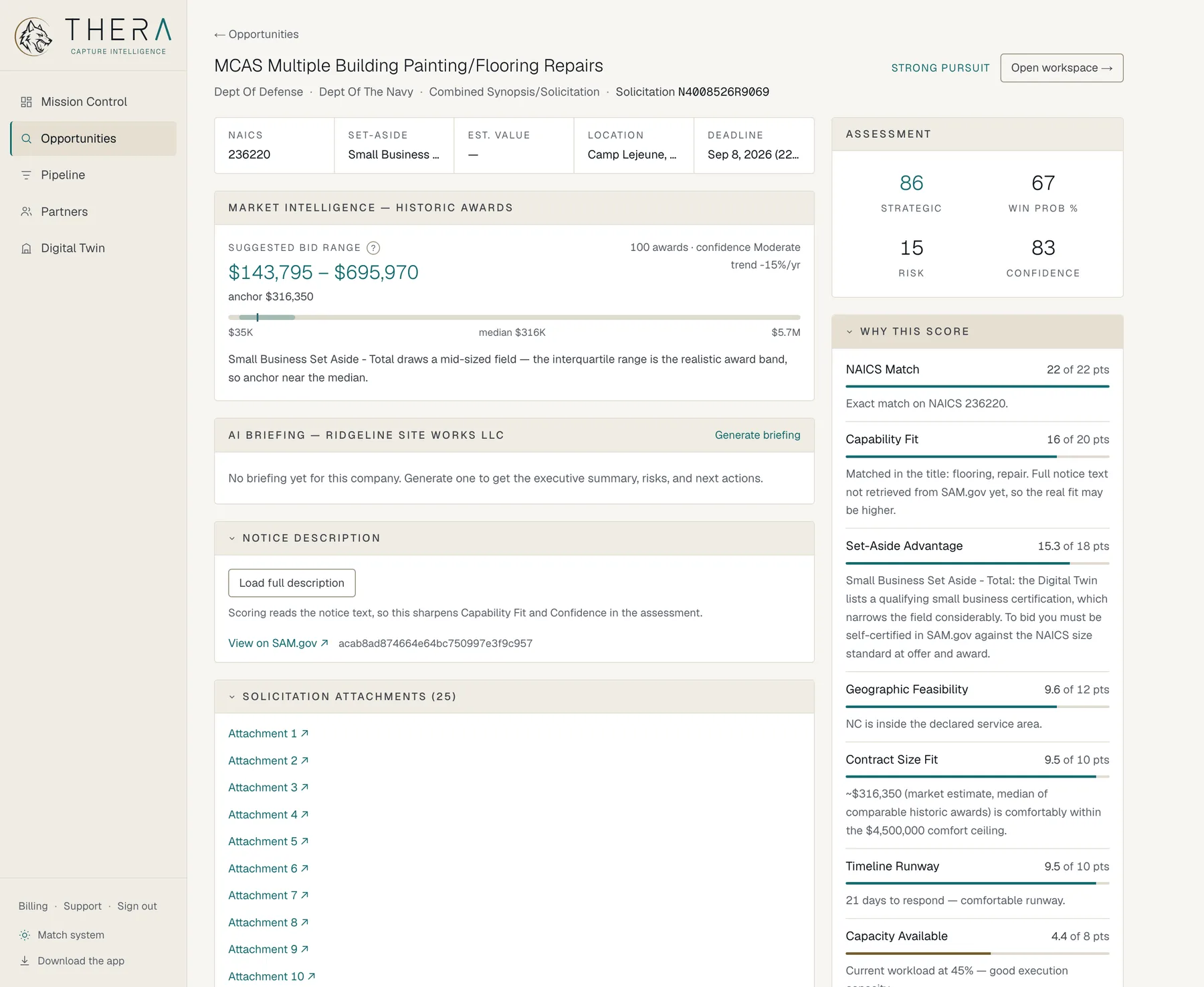
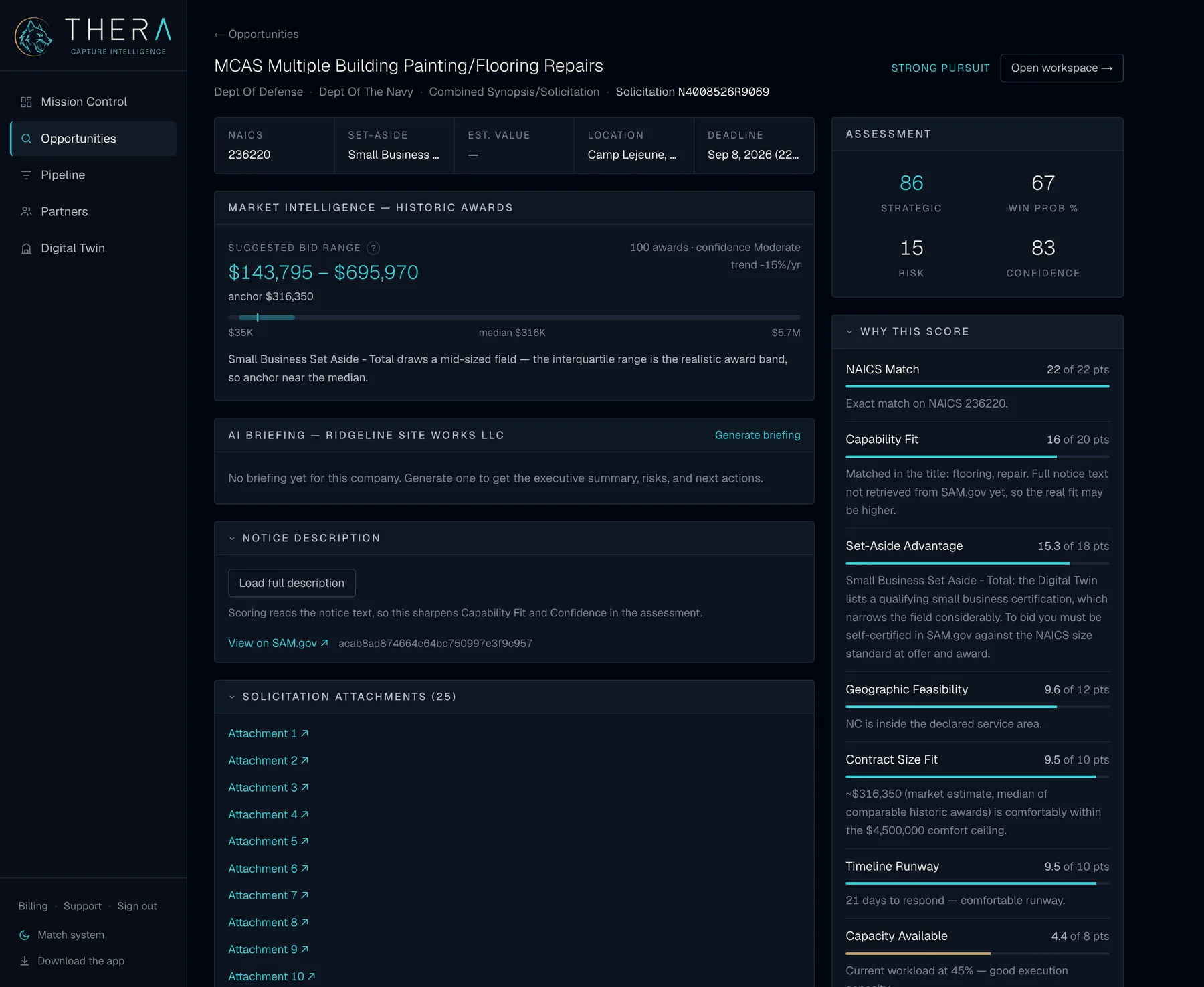
Mission Control, then 432 live notices ranked against the company profile. Opening one shows the score broken into seven weighted factors, and the workspace behind it carries the checklist, the market bid range, and the drafting panel.
Find the team
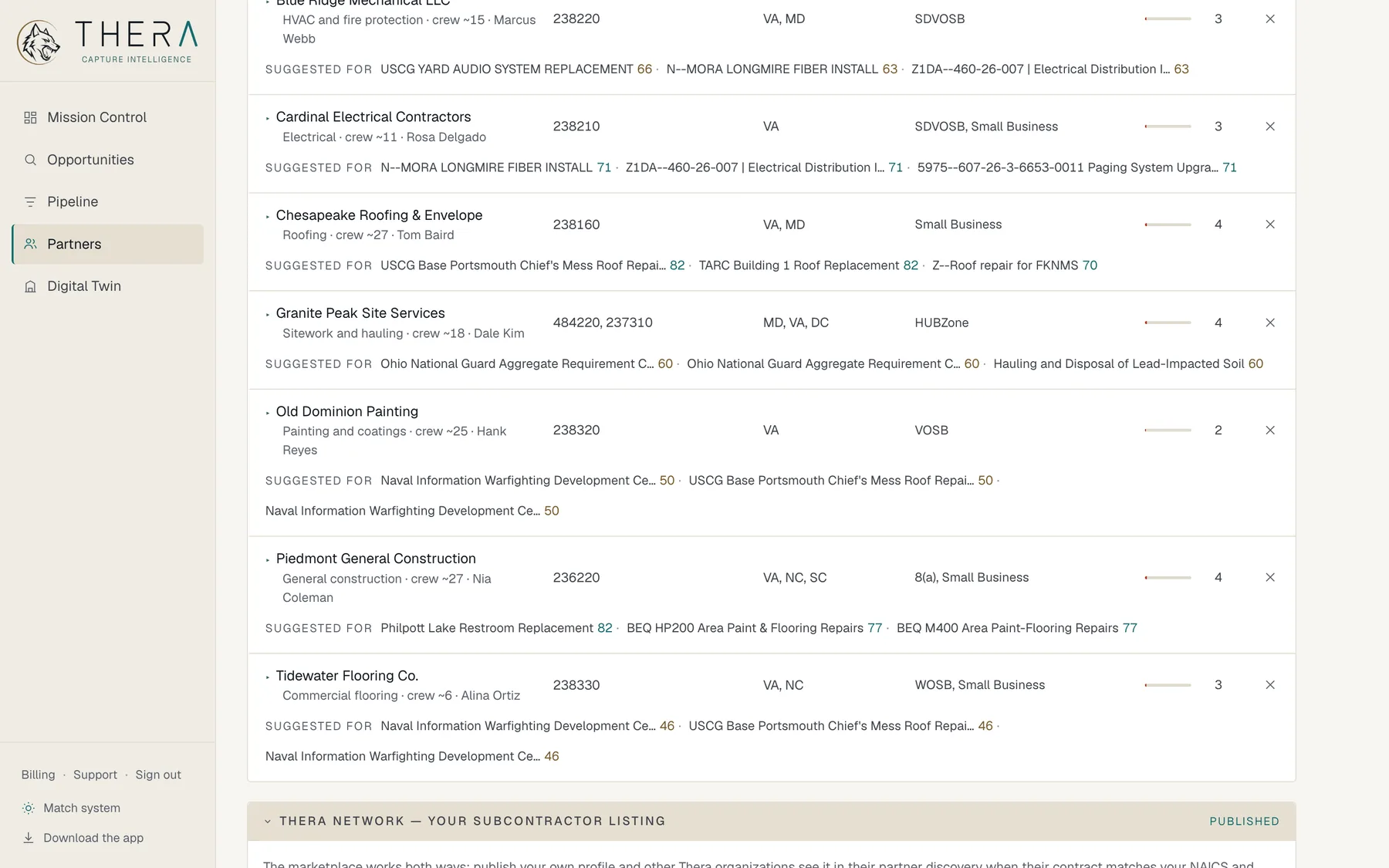
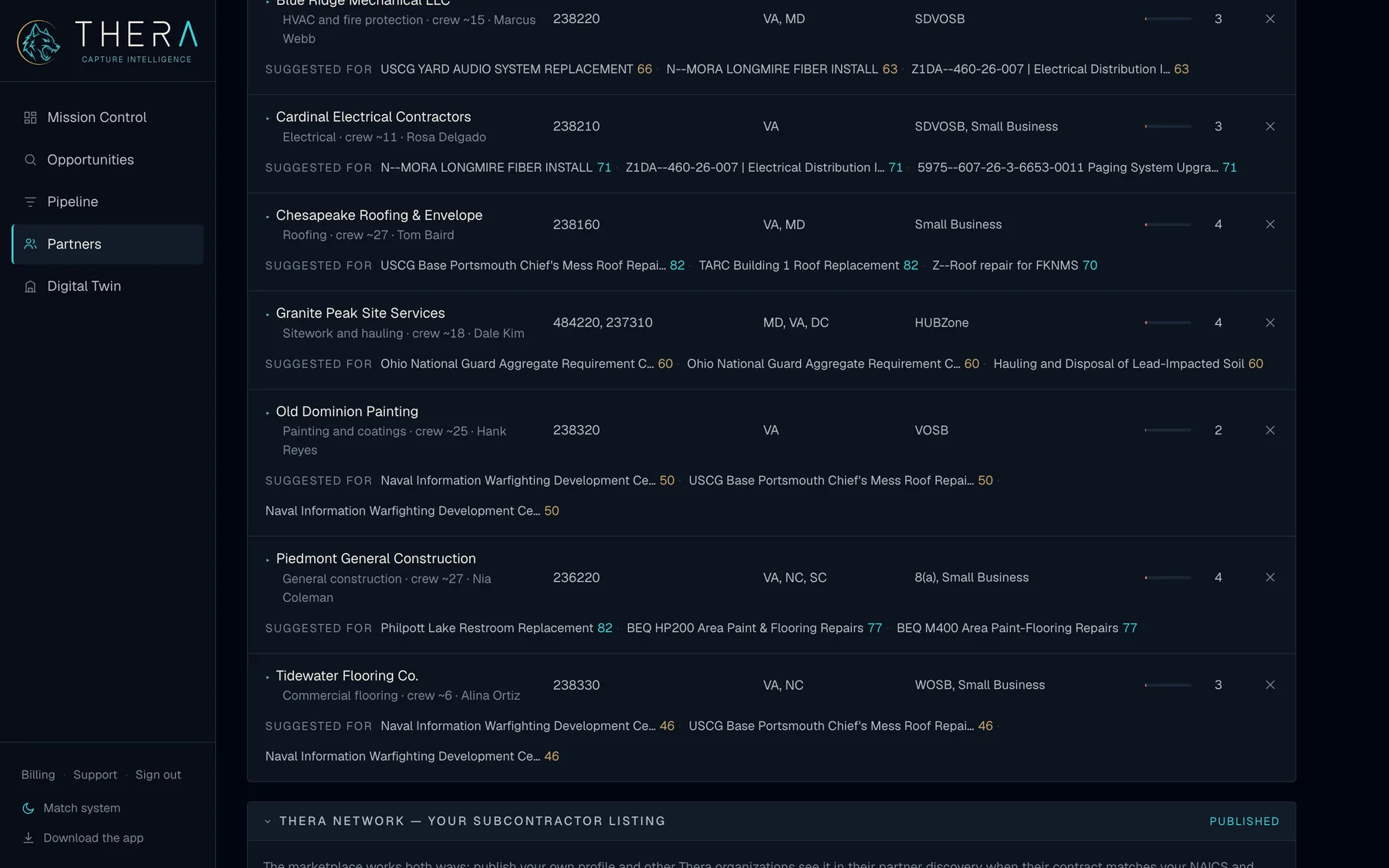
Partners ranked for one specific notice, new firms surfaced out of public federal award data, the two-way network listing, and the Digital Twin every one of those matches is made against.
The full tour
Both halves end to end, at the pace of someone actually working: discovery through to a bid package, and the teaming that goes with it.
Scoring Engine · Explainable
Bid or no-bid, with the reasoning shown
Every recommendation traces back to your Digital Twin and the notice itself. Your overrides and win/loss outcomes tune the engine for your organization alone.
Signals In
Live SAM.gov notices and amendments, USAspending award history, and your Digital Twin.
Scores Out
Strategic fit, win probability, and risk flags, each with the evidence behind it.
Decision Made
A defensible bid/no-bid call, a pursuit plan, and partners ranked for the team.
The Thera Network · Opt-In
One profile, pointing both ways
Capability is rarely what keeps a small firm out of federal work. Being unknown is, and there is no list to get onto.
You need a partner
Thera ranks subcontractor candidates for the notice in front of you, drawn from public federal award data, with network members above them.
Someone needs you
Your listing is matched on NAICS and service area and returned inside their search for a live contract, carrying the contact details you chose to publish.
Off until you switch it on. Unpublish and you are out of every search immediately, and nothing about your pipeline, scores, or drafts is visible to another member at any point.
Federal contracting teams drown in notices: thousands of postings, constant amendments, and a bid/no-bid call that usually comes down to gut feel under deadline pressure. Most procurement tools stop at search: they answer "what contracts exist?", not "what should we pursue?"
Thera is built for the second question: given your capabilities, certifications, past performance, and capacity, which opportunities are worth pursuing, with whom, and with what probability of winning.
There is a harder question underneath "with whom". Capability is rarely what keeps a small firm out of federal work; being unknown is. Primes team with the companies they can name, and there is no list to get onto, so good subcontractors wait to be found by people who have no way to find them. That is what the Thera network is for, and it is why one profile works in both directions.
Thera was not a product idea looking for a market. It was a request. Cerberus Contracting LLC, a veteran-owned government contractor, needed a better answer than spreadsheets and gut feel to the question every small GovCon firm faces weekly: of the thousands of notices on SAM.gov, which handful are actually worth our time?
We should be straight about the relationship, because you would find out anyway and it changes how you read the rest of this page. Cerberus is co-owned by our founder alongside two other veterans. It is a design partner, not an arm's-length customer, and nothing here should be read as an independent reference.
What it is instead is a real operator with real money on the line. Cerberus runs its capture pipeline in Thera: live opportunities, real deadlines, real bid and no-bid decisions, and outcomes that show up in their revenue rather than in a metrics dashboard. Every feature below survived contact with people who lose work if the tool is wrong. That is a harder test than a customer interview, and it is the reason Thera scores opportunities instead of just listing them.
It was theirs alone while the feedback loop needed to be one firm deep. That circle has widened: Thera is open for signup, with a 14-day free trial and no card required to start. Cerberus still runs its pipeline on it and still shapes what ships next. That has not changed, and neither has the disclosure above.
What It Does
- 01
Opportunity Discovery
Continuous SAM.gov sync across solicitations and pre-award notices, with amendment change tracking and deadline monitoring.
- 02
Digital Twin
A living representation of your company: capabilities, certifications, past performance, capacity.
- 03
Explainable Scoring
Bid/no-bid recommendations with visible reasoning: strategic fit, win probability, risk flags. Never a black box.
- 04
Eligibility Gating
Set-asides checked against your certifications, so a contract you cannot prime never ranks like one you can.
- 05
AI Opportunity Briefings
Claude-generated executive briefs per opportunity: scope, risk factors, and recommended next actions.
- 06
Pipeline · Mission Control
Run every pursuit from watchlist to submission: stages, tasks, a compliance checklist, and pricing scenarios benchmarked against historic awards.
- 07
Partner Matching
Teaming and subcontractor candidates found in public federal award data, ranked by capability, geography, and certification alignment. Each arrives with its registered address, a named point of contact where the government publishes one, and links to its SAM.gov and USAspending records.
- 08
The Thera Network
Publish an opt-in listing and your company is returned inside another member's partner search for a live notice, ahead of the cold leads. Off by default; unpublish clears it instantly.
- 09
Award Evidence
A listing takes your UEI and Thera fetches the public federal award record against it. Every other line on a listing is written by its owner, and a prime reading it knows that; this is the one the government recorded.
- 10
Listing Impressions
How many times your listing surfaced in a real partner search, for how many distinct contracts, under which NAICS, and when last seen. Never who looked. Which primes are shopping for a partner is their business.
- 11
Outreach Composer
A first approach drafted from what is already on screen: the agency, the solicitation number, the NAICS, and the days left. A template rather than an AI call, because its only job is to be accurate. Editable, because the sender owns every word.
- 12
Branded Submission Packages
Export approved sections to .docx carrying your own logo and colors, with the contrast floor enforced so it still reads on paper.
Priced in the Open
$200/mo$2,000/yr · 14-day free trial
$200 per month for one company profile, plus $100 per month for each additional profile, so a firm bidding under two entities pays $300. Annual billing is $2,000 a year for a single profile, which works out to two months free. Every account starts with a 14-day free trial: no card required, every feature including the network, and every SAM.gov notice scored exactly as it is on a paid plan. The trial includes three bid workspaces and 30 AI generations in total. Billing only begins if you choose to subscribe.
Talk to Us About TheraDocker on EC2, in its own AWS account
One server and one database, on a dedicated encrypted volume that AWS Backup snapshots on a schedule, in a separate AWS account from every other product. The scoring engine never reads another customer's data; a network listing is the only thing that crosses between organizations, and only if you publish one.
- Next.js
- FastAPI
- SQLite
- Anthropic Claude
- SAM.gov API
- USAspending.gov
- PWA
- Docker
Common Questions
Related Reading & Services
Thera: Scoring Federal Opportunities for a Contractor With Money on the Line
How we built capture intelligence for federal contractors around one hard rule, that a score has to be a gate rather than a ranking, with a design partner who loses work when the tool is wrong.
6 min read
Nobody Got the Password Reset, and Two Different Reasons Why
Two systems decide whether a reset email arrives, they fail identically from the customer's side, and confusing them cost us weeks. Plus the DNS write that nearly deleted a record we were not editing.
9 min read
The Power of Privacy: How Ephemeral Backends Make Our Products Harder to Breach
You can't leak what you never stored. How one architectural decision, backends that hold as little user data as possible for as short a time as possible, runs through Aegis BI, MyBudgetNerd, and Thera, and why it's a security strategy, not just a privacy stance.
10 min read
AI Agents with a Human in the Loop: Trustworthy Automation
The AI agents that survive real operations share one principle: they recommend, humans decide. How we build agents that earn trust rather than demand it.
2 min read
Ready to Deliver Your Next Data Product?
Share your goals by email and we will respond with a practical next-step plan for scope, timeline, and delivery.



© 2026 Athena Data Labs
A division of Athena Analytics L.L.C.